Most copywriters have never closed a deal.
I've been closing them for forty years. That's why the copy on the other side of this page does a job most copy can't.
You've landed here from a job post, a cover letter, a LinkedIn ping, or a referral. Either way, you're looking for a writer, and I'd wager you've been through a stack of them this week. Most read like the same person wrote them using the same three prompts.
I understand the fatigue. Everyone "gets your audience." Everyone writes "conversion-focused copy." Everyone is "AI-powered" now. After the twentieth application, they blur into one tired silhouette.
I'm a different animal, and this page is the proof. Give me five minutes. Either I'm the answer to what's been bothering you about every other applicant, or I'm not, and you close the tab with one less candidate to vet. Fair trade either way.
The writers who sold things
Every great copywriter in history was a salesman first. Eugene Schwartz wrote mail-order ads that moved millions of dollars of product before most of Madison Avenue knew his name. Gary Bencivenga, the writer every working copywriter still quotes, spent three decades testing pitches against live buyers. Claude Hopkins, Joe Sugarman, David Ogilvy, John Carlton, Gary Halbert. Every one of them sold before they wrote.
The pattern matters. Sales experience is what built the entire direct-response canon. Good copy does what a good salesperson does, translated onto the page. It handles the objection before the reader has even finished forming it, and leads with what the buyer came here to solve rather than what the writer is trying to say. When the close lands, it lands because the writer knows what closing actually feels like from the far side of the transaction.
You can't learn that on a writing course. You only learn it standing across from someone who said no, and working out why. That's the school I came up through.
Forty years. Not rounded up.
The number on most bio pages is "10+ years." I've been doing this for four decades.
Occasionally you'll see "20+" on a bio page if the writer is feeling bold. I've been in sales and marketing for forty, and the first twenty-five were face-to-face, across wildly different verticals.
A short list of what I sold, roughly in order:
Milk, door to door. Cold mornings, warm objections, the occasional dog. First lesson of the whole career: people rarely say no to what you're selling. They say no to how you're asking.
Cars. Twenty-five years in automotive retail. I watched every buyer type walk through the showroom... the price-shopper, the feature-bargainer, the one who already decided before they walked in, the one who'll never decide no matter what you do. I learned to tell them apart inside thirty seconds.
Water filters. Phone systems. Oil. Industrial kit I wouldn't wish on my worst enemy. A strange shopping list on paper, and every line of it taught the same lesson. Whatever I was selling, buyers hesitated in the same places and committed for the same reasons.
In 2005 I built my first website, ranked a health page on Google's first page back when ranking was half craft and half animal cunning, and realised the game I'd been playing in car parks and on doorsteps was the same game, translated onto screens. SEO, funnels, list building, email sequences. All of it bent around the same buyer psychology I'd been reading in real time for decades.
You can't fabricate that. Either the marks are on you or they aren't. Mine are.
The production engine I built myself
Forty years of sales instinct is half of what I bring. The other half catches most marketing directors sideways, because most agencies are still pretending AI is a next-year problem.
I run a proprietary production system I've built and hand-tuned over two years. Think of it as an engine room with sixty-plus specialised modules, each doing one job, scored and gated before it leaves my desk. The whole thing is mine. I designed it, I built it, I maintain it, and I'm the only person who knows how every piece fits together.
The system checks every piece against a detection framework I built specifically for this... multiple categories, scored, averaged, and gated at a pass threshold. Anything below the gate goes back for another pass. It also audits whether pages will actually get cited by ChatGPT, Perplexity, and Google's AI Overviews, because traditional SEO alone doesn't cover the citation surface any more. And it puts every piece I write through a final human-voice pass before anyone else reads it.
Every piece I produce clears the full pipeline. I draft it, then the detection framework strips the AI tells, and from there I rebuild the rhythm and British idiom by hand, running the whole thing through a final hostile-editor score before it can move. Miss the gate and it goes back around. Nothing ships until it passes.
Calling that "AI-powered" undersells what's running. I built the production pipeline from scratch, on top of models I understand at the API level, with quality gates most agencies haven't even scoped yet. It's why work I deliver reads like a person wrote it on a good day, not like a prompt got lucky.
This is the part of the page where I lose most candidates you've already interviewed. They've got a ChatGPT subscription and a Notion template. I've got two years of hand-built infrastructure plus forty years of sales experience teaching the system what good actually looks like. Nobody on the candidate pile is bringing that combination, and you can't shortcut it. You'd have to spend two years building the engine yourself, and you'd still need someone with the sales miles to teach it what to gate.
The other thing worth saying out loud: hire me long-term and the engine compounds. Every brief I run through it teaches it more about what good copy looks like in your sector. Three months in, the system is calibrated to your business specifically. Twelve months in, it's an asset most of your competitors will never have access to. The system comes with me when you hire me.
If you're already thinking that's what you've been looking for, scroll to the bottom. If you want receipts first, they're next.
What that combination produced
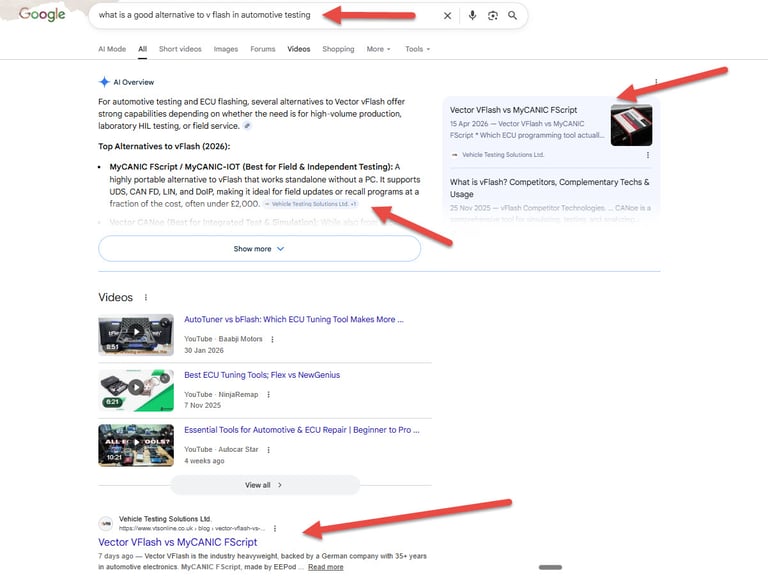
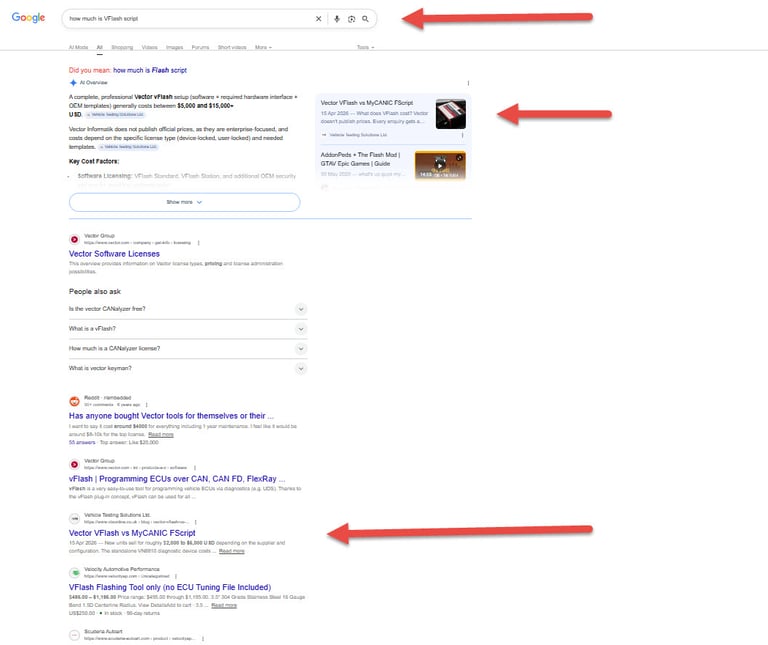
Vehicle Testing Solutions is a UK-based B2B automotive testing consultancy I work with part-time as their AI search and content lead. I built their generative engine optimisation strategy, their AI answer page system, and their technical content covering CAN bus, ECU reprogramming, OBD diagnostics, and integration testing white papers. One public example: their Vector vFlash vs MyCANIC-FScript breakdown. It ranked on page one of Google within twenty-four hours of publishing and has been getting cited across multiple AI Overview queries ever since. That was the whole point of writing it.
A content agency came to me with a brief process chewing six to eight hours per article. Their senior writer was drowning. I built them a Custom GPT trained on their brand voice, client archive, and brief structure. The same work now lands inside forty-five minutes. They stopped losing juniors to burnout.
An e-commerce brand asked me to rewrite their product descriptions. Same range, same traffic, same audience. I applied the psychology I used selling cars in showrooms... answer the real objection, not the stated one. Conversion rate up thirty-four percent in eight weeks.
A coach who used to dread writing promotional emails asked for help. I built her an AI email copywriter trained on her voice. She went from sending one email a quarter to one a week. Her list started growing again, and her campaigns convert forty percent better than the old baseline.
"I was sceptical about AI replacing our copywriting process. John showed us how to use it as a tool, not a replacement. Our email campaigns now convert 40% better, and I actually enjoy writing them again."
Mat · Carpentry business owner
I've built over a hundred websites for myself and clients across two decades. A good number flew. Plenty crashed in beta, some of them spectacularly. The range is the point. I've watched enough outcomes, good and ugly, to know what the good ones have in common.
How this works
You talk to me. You deal with me. No juniors, no hand-offs.
Most agencies lead with a shiny pitch deck and deliver with a junior two tiers below the one you met in the meeting. I don't run that way because I can't. The operation is me, the engine I've built, and a small bench of trusted specialists I pull in only when a project genuinely needs them.
I take on full-time roles, contract engagements (typically three to twelve months), fractional content lead positions, and selected project work. Whichever shape suits your team, you get my full attention on your work and the engine comes with me. I reply personally inside twenty-four hours, usually faster. I'll tell you plainly when something won't work, and I'll show you the simplest path when something can.
Turnaround depends on scope. A standard long-form content piece clears the full pipeline in three to five working days. A full sales page like this one, complete with strategy, voice research, and multiple audit passes, takes about a week. Salary, day rate, or project pricing gets agreed against the shape of the work, not a rate card.
None of that is outsourced. None of it is pre-templated. Every engagement starts with a real conversation about fit, because life is too short to take on work I can't do justice to.
Who this isn't for
Not every hiring manager is a fit. I've learned that the hard way.
Trying to wedge a square peg into a round contract loses both sides money, and nobody enjoys the conversation that ends it. Better to be plain up front.
If you're hunting for the cheapest writer on the pile, you're in the wrong place. There are plenty of hands cheaper than mine, and good luck to them. The same goes for anyone shopping for generic AI slop that reads like a robot had a sleep paralysis episode. Hundreds of people will happily supply that too. And if you think copy is "just words on a page," the first conversation we have will be uncomfortable for both of us.
I put every piece through proper research, intent-driven writing, an anti-AI audit, and a final humanise pass before I let it out of the door. That process takes real time and real skill, and it isn't cheap. If any of that sounds like friction, I'm not your answer.
On the other hand, if you want a writer who closed thousands of deals before writing his first paid line of copy, brought a production system most agencies haven't even scoped, and replies personally to every message instead of funnelling you into an autoresponder... you're in the right spot.
The conversation
Two ways to talk. Both go to me.
Email me or message me on LinkedIn. Tell me what you're hiring for, what your team looks like, or what's been missing from the writers you've already seen. I reply personally, inside twenty-four hours, and I mean me typing into an inbox, not a virtual assistant sending a templated holding message.
There's no booking funnel, no autoresponder sequence, and none of the "I've only got a couple of slots this week" theatre designed to fake urgency. Just a reply from a person who's been doing this since before most of your team started school.
You've read this far, which means you've already done the filtering. Either the combination makes sense for what you're building, or it doesn't. You'll know what to do next.
Yours in the trade, John
Two ways to start the conversation
Email me: hello [at] blueorchan.com
Message me on LinkedIn: LinkedIn Page